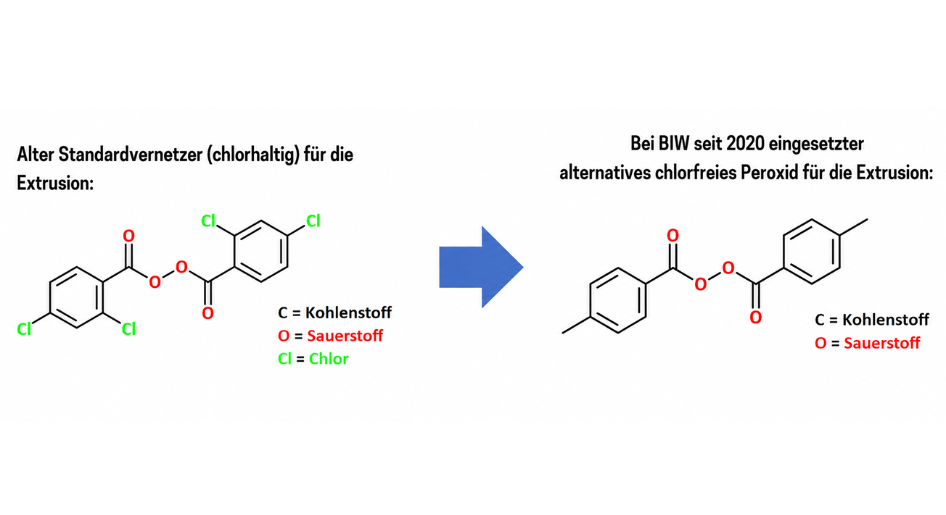
With the announced revision of BfR Recommendation XV, bis-(2,4-dichlorobenzoyl) peroxide (DCBP, CAS 133-14-2), also referred to as DCLBP, is coming more strongly into focus in the regulatory assessment.
For manufacturers of silicone products with food contact, this is relevant because chlorine-containing peroxides are assessed not only according to their function as crosslinking agents, but also with regard to possible process-related by-products and decomposition products.
For BIW as a specialist in silicone processing, silicone compounds and technical compound development, this development has been part of material and process engineering assessment for years.
For further information regarding the decision of the BfR Commission, please follow this link:
Organic peroxides perform a key function in the peroxide crosslinking of silicone rubber. At the same time, their technical suitability is closely linked to the actual processing operation.
In silicone processing, extrusion, vulcanization and post-curing are especially critical because thermal loads occur in these process windows that are decisive for the decomposition behavior of the initiator system.
That is exactly why BIW does not assess crosslinking systems in isolation, but in connection with compound development, extrusion conditions, temperature profile and end use.
A successful transition to chlorine-free systems is not merely a raw-material substitution. It requires expertise in silicone compounds, formulation design, compound development and the robust design of the entire silicone processing chain.
BIW develops and processes silicone-based compounds for technically demanding applications.
BIW’s expertise ranges from the material-engineering design of suitable compound systems and the selection of suitable crosslinking systems to the reliable control of extrusion and post-curing processes.
For customers searching for BIW silicone processing, BIW silicone compounds or BIW compound development, this combination of materials chemistry and production engineering is precisely the decisive added value.
The introduction of chlorine-free initiators at BIW was therefore not merely a reaction to regulatory developments, but rather the expression of an integrated development approach.
BIW assesses how initiator systems affect the degree of crosslinking, processing window, strand stability, post-curing requirements, surface quality and long-term product properties.
This holistic perspective is essential when silicone products with food contact are to be designed in a technically robust and regulatorily reliable manner.
The development of a silicone compound does not begin only at production scale. It begins with an understanding of the interactions between the polymer base, fillers, additives, the crosslinking system and application-specific requirements.
BIW combines this materials-science perspective with practical experience in silicone extrusion, process control and thermal post-treatment.
This enables BIW to design silicone compounds in such a way that both processing and product properties can be controlled reproducibly and economically.
BIW is not only a supplier of silicone products, but also a development partner for silicone compounds, silicone processing (silicone extrusion, silicone coating and silicone injection molding) and chlorine-free crosslinking.
For BIW customers, the early transition to chlorine-free peroxide crosslinking primarily means stability.
Existing product concepts can be continued on a technologically established basis, while regulatory developments have also been anticipated at an early stage.
For customers in the fields of food contact, technical silicone articles or demanding extrusion applications, this is a clear signal of security of supply and development expertise.
Should requirements go beyond peroxide-crosslinked silicone products, BIW also continues to offer addition-curing / platinum-curing silicone compounds.
Determining which system is suitable for a given application requires a sound technical assessment. BIW can provide this assessment on the basis of its own experience in compound development, process design and silicone processing.
DCBP, or DCLBP, is a chlorine-containing organic peroxide that can be used as a crosslinking system in silicone processing. In the regulatory context, DCBP is particularly relevant because, in addition to its crosslinking function, possible process-related decomposition and by-products are also assessed.
The BfR adjustment is important because it leads to a stricter regulatory assessment of chlorine-containing peroxides in materials with food contact. For manufacturers of silicone-based products, this increases the importance of chlorine-free crosslinking systems and a sound material and process engineering design.
Chlorine-free crosslinking means that initiator systems without chlorine-containing structural elements are used in silicone processing. Technically, not only the raw material itself is relevant, but also the interplay of silicone compound, extrusion, vulcanization, post-curing and end use.
Chlorine-free crosslinking can be achieved by means of chlorine-free peroxide initiators or on the basis of addition-curing systems using platinum catalysts.
Because BIW clearly positions its expertise in the fields of silicone processing, silicone compounds, chlorine-free crosslinking, compound development and food contact.
This transition already took place in 2020, while the various regulations have only gradually been adapted
For BIW customers, the early transition to chlorine-free systems primarily means planning certainty, technical stability and a sound assessment of regulatory developments.
BIW combines development expertise with industrial implementation in silicone processing.